Run your business from one Slack channel: the case for chat-native operations
The tool your team already opens first every morning
Ask an SMB owner where work actually happens and the honest answer is rarely "our project-management platform." It is the chat app. Slack, WhatsApp, a Teams channel. That is where decisions get made, files get dropped, and "can you just quickly…" requests get fired off between other things. The formal tools are where work gets recorded after the fact, if at all.
So the interesting question is not "which new dashboard should we adopt." It is: what if the place your team already lives all day could also do the work, not route a ticket to a human, but actually produce the output? That is what we mean by chat-native operations, and it is the operating model we run our own company on.
What "run it through Slack" actually means
There are three moving parts, and none of them are exotic:
- One channel as the control room. A single Slack channel is where requests go in and results come back. No new app to learn, no separate login, no context-switch.
- A shared board. A Slack List (or equivalent) sits in the channel as the visible backlog: what is requested, what is in progress, what is done. Everyone sees the same state.
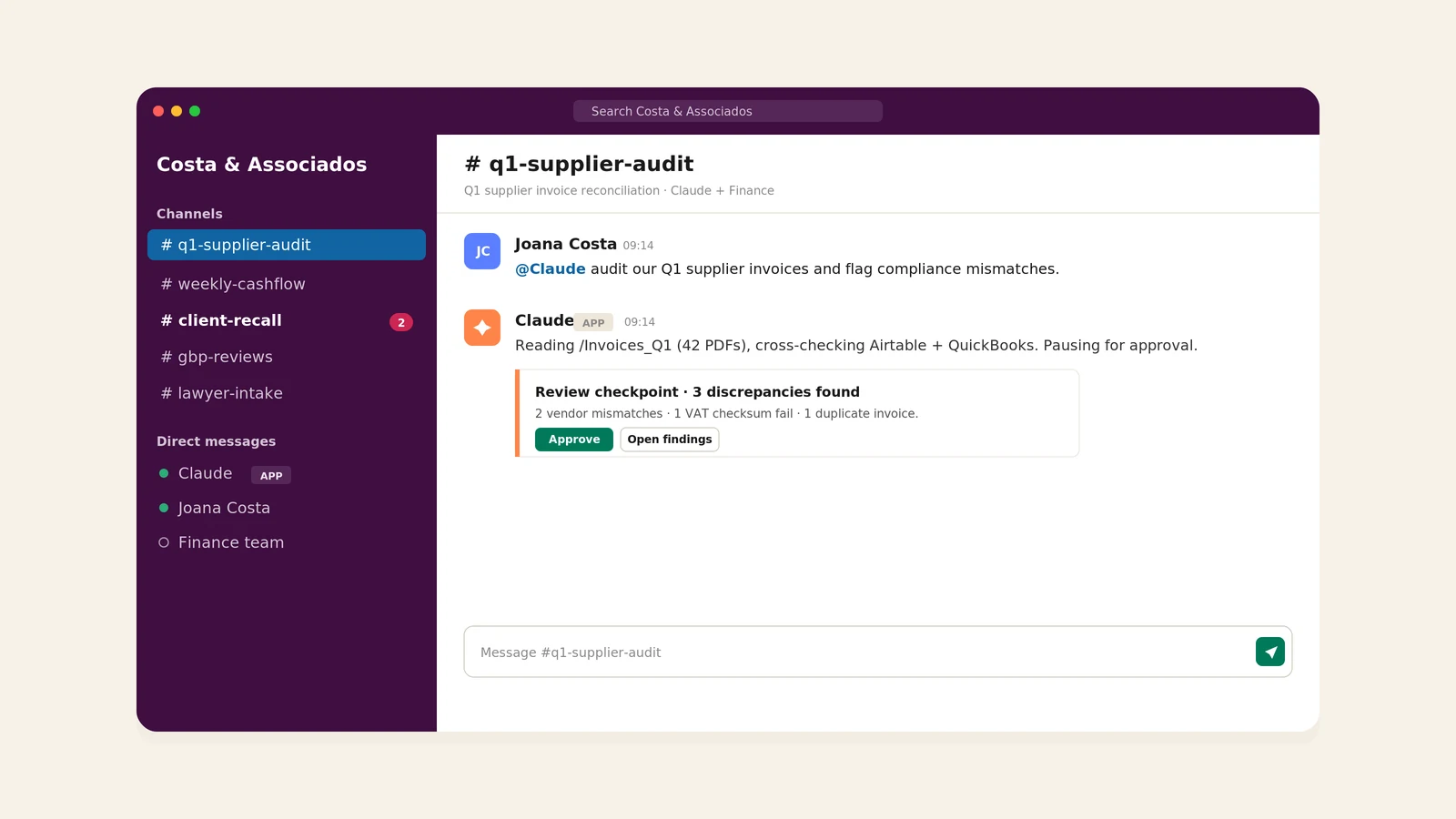
- An AI executor in the channel. This is the part that is genuinely new. You mention the assistant, describe the task in plain language, and it carries it out: drafts the document, builds the page, updates the record, sends the email. Then it reports back what it did and where, in the thread, so it is visible and reversible.
The difference from a chatbot is the verb. A chatbot answers. An executor produces a finished artifact and puts it in front of you for approval. You direct; it does.
Why it works for a small business specifically
Enterprises can afford an operations team to sit between the owner and the work. An SMB owner is the operations team. Chat-native operations fits that reality in a way a heavyweight platform never will:
- Zero adoption tax. The interface is a conversation. If your team can send a message, they can use the system. Nobody has to be trained on a new UI.
- One place, one thread of truth. The request, the work, the result, and the approval all live in the same thread. No hunting across email, a drive, and a task tool to reconstruct what happened.
- The owner stays the approver, not the doer. Because the executor produces to a preview and waits for your OK before anything goes live, you move from doing the work to signing off on it. That is a few hours of oversight instead of days of production.
- It scales by adding channels, not headcount. A new function, client, or workflow is a new channel with the same pattern behind it, not a new hire and a new tool.
The honest limit: this works when the output is something an AI can genuinely produce and a human can quickly verify: documents, drafts, web pages, data updates, research, first-pass designs. It is not a replacement for skilled judgment; it is a way to compress the distance between "I need this" and "here it is, approve it."
A worked example: the Website Production Channel
The cleanest way to show the model is a product we run on it. The Website Production Channel is a packaged version of chat-native operations built for one job: producing client websites on demand, at volume, for a reseller.
What it is. A reseller (an agency, a freelancer, a marketing consultant) gets a private Slack channel with our AI executor in it. They fill in a fixed order form for a client site. The executor builds three distinct design options. The reseller's client picks one. The reseller approves. It ships. The reseller sells the finished sites to their own clients at their own price; we are never in front of their customer.
How it runs. It reuses exactly the setup described above: a channel plus a shared board, an AI executor that builds to a live preview, and the reseller sitting in the channel as the approval gate. Build-to-preview, then a human OKs the go-live. The reseller never touches code and never becomes the editor; they stay the approver.
What is included. Each site runs up to five pages, delivered with three design options, two rounds of tweaks, and a set of AI-generated images, packaged as a fixed monthly volume, with room to add more sites when a month runs hot. Hosting stays with the reseller. It is a clean handoff, so we never carry their clients' infrastructure and they keep full control of the relationship.
Who it is for. Anyone who sells websites as part of their offer but does not want to run a production team to deliver them: agencies that want to expand capacity without hiring, freelancers who want to take on more than they can build alone, consultants who want a web line-item they can resell with a healthy margin. The model replicates cleanly: one reseller, one channel, repeated.
The gate that makes it safe
The reason owners trust this model is the approval gate. Nothing the executor produces goes live on its own. It builds to a preview, posts what it made and where, and waits. A person, you or your client, looks and says yes. That single design choice is what turns "AI that does things" from a risk into leverage: the machine absorbs the production time, the human keeps the judgment and the final word.
That is the whole thesis of chat-native operations. Not autonomy for its own sake, but compression. The work collapses into the place you already are, the executor does the heavy lifting, and you stay exactly where you should be: directing and approving, not producing.
Where to start
If your business runs on a chat app all day, you already have the substrate for this. The question is whether the work can move into the same place. We help SMBs and resellers stand up exactly this pattern: a channel, a board, and an executor scoped to the jobs that matter to you, with the approval gate wired in from day one.
If you want to talk through what your version would look like, the first thirty-minute call is free and there is no obligation in it, just a conversation about which of your workflows are ready to move into the channel.
Ready to transform your business?
Discover how our AI automation solutions can streamline your workflows and reduce operational costs.
Schedule a Free Consultation