The headless CRM: the interface was never the product

Nobody has ever wanted to use a CRM
This is the thing the industry does not say out loud. In fifteen years of CRM software, the central complaint has never changed and has never been solved: the people whose knowledge the system needs are the people least willing to sit down and type it in. Sales reps do not update deals. Clinic receptionists do not tag patients. Tradespeople do not log the call they took from the van. The data is not missing because they are lazy. It is missing because the interface asks them to stop doing their job in order to describe their job.
Every generation of CRM has responded to this the same way: build a better screen. Cleaner forms. Fewer required fields. A mobile app. Drag-and-drop pipelines. Bulk edit. Inline edit. Kanban. Each iteration made the tax slightly less painful, and none of them removed it, because the tax was never in the design of the form. The tax was the form.
Which is why the interesting thing happening right now is not a better CRM. It is the CRM losing its interface entirely.
What "headless" actually means here
The term is borrowed. Headless commerce and headless CMS both did the same trick a decade ago: separate the thing that stores and serves the data from the thing that presents it. The store keeps the products; the storefront becomes one of many possible surfaces on top. The CMS keeps the articles; the website is just one place they can appear.
A headless CRM is the same split applied to business records. The record store (customers, jobs, matters, appointments, invoices, notes) becomes exactly what it always secretly was: a database with good structure and a clean API. And the interface, the part everyone thought they were buying, gets deleted.
The obvious question is what replaces it. For ten years the honest answer was "nothing you'd like". An API is not a user interface, and telling a clinic owner to use an API is telling her to hire a developer. The reason this is worth writing about in 2026 and not in 2019 is that the replacement finally exists, and it is conversation.
The interface existed because software could not understand you
Here is the part worth sitting with. The graphical interface was never the point of a CRM. It was a workaround.
Software could not understand intent. It could not take "Maria called, she wants to move Thursday to the following week and she asked about the price of the second session" and turn that into three record updates and a follow-up task. So we built a structure that made intent legible to a machine that had none: dropdowns, required fields, defined stages, mandatory tags. The form was a translation layer, and the human was doing the translating, for free, badly, and last thing on a Friday.
That constraint is gone. A model that can read the sentence, resolve "Maria" against the right record, understand what moving Thursday means for the calendar, and know that a pricing question needs a human answer, is a translation layer that does not need the human to be the translator. The dropdown was scaffolding around a limitation that no longer holds. You do not keep the scaffolding once the building stands.
What the stack looks like without a head
Three layers, and only one of them is new:
- The record store. Boring on purpose. A well-structured database (Airtable, a Postgres instance, whatever fits) holding customers, jobs, appointments, notes, money. It has a schema. It has relationships. It has an audit trail. It has no opinion about how anyone looks at it.
- The tool layer. This is the connective tissue, and it is the part that changed. A protocol, MCP in our case, that exposes the record store, and the other tools around it, as things an AI can actually operate: read this table, create this record, send this message, check this calendar. It is an API with a description of itself attached, which turns out to be the difference between a machine that can call a function and a machine that knows when to.
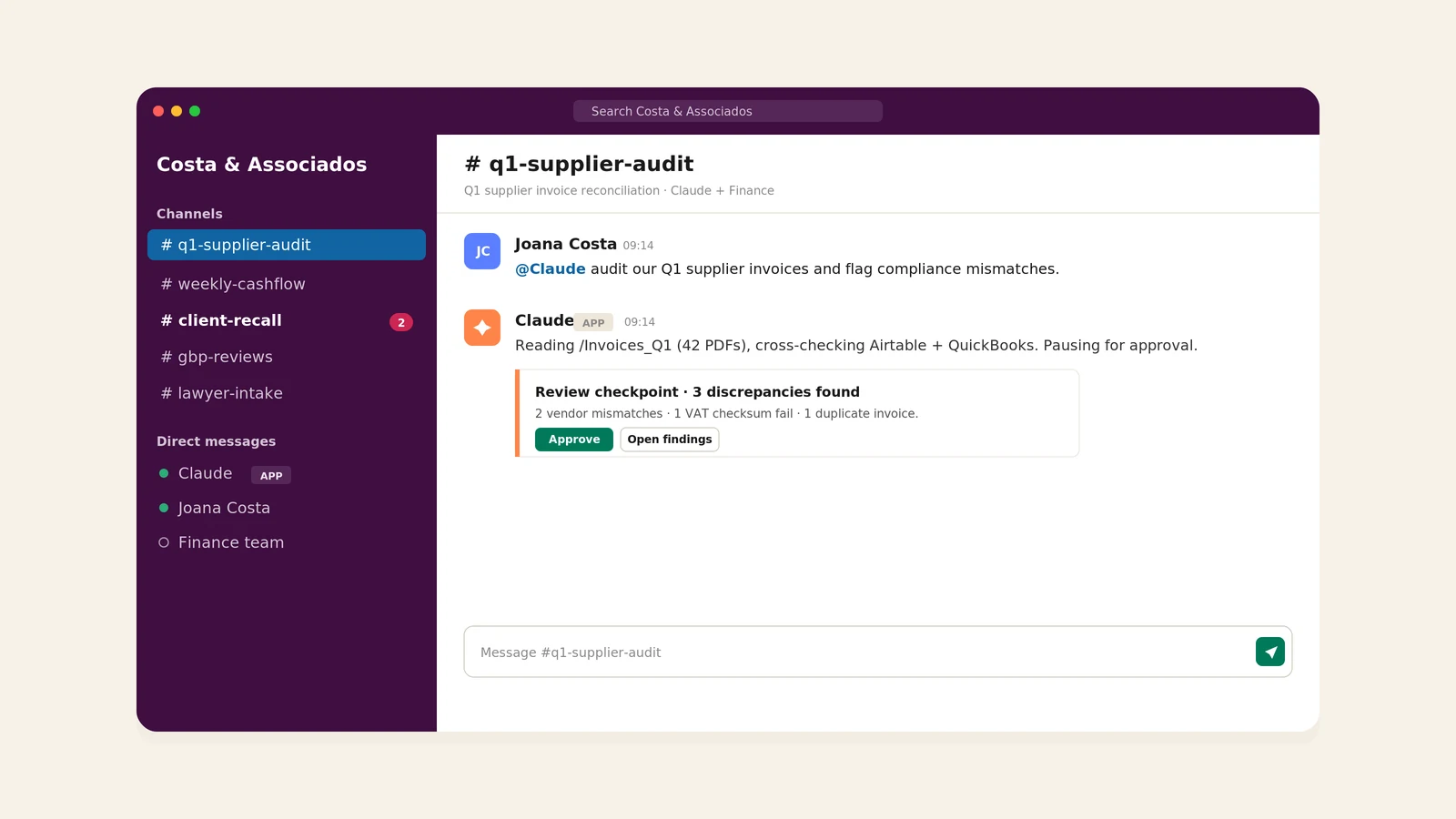
- The surface. Conversation. The owner says what happened or what they want, in the language they already use. The system does the record-keeping as a side effect of the sentence, and comes back with what it did.
Note what disappears in that list: the CRM as a destination. There is no app to open. There is no screen where you go to do CRM. The record-keeping stops being a place you visit and becomes a by-product of describing your day.
The subtraction, stated plainly
We measure these systems by what stops happening, not by what starts. Headless removes:
- The data-entry tax. No one types into the CRM, because there is nothing to type into. The record updates fall out of a message that was going to be sent anyway.
- The training. There is no UI to learn, so there is no onboarding, no seat-by-seat rollout, no "we bought it but the team never adopted it". That is the failure mode that kills most CRM purchases and is never in the vendor's case study.
- The stale-data problem. A CRM's data goes stale because updating it is a separate act from doing the work. When updating it is doing the work, the staleness has nowhere to come from.
- The reporting theatre. You stop building dashboards for questions you anticipated and start asking the questions you actually have. "Which patients haven't been back since the spring, and which of them booked more than once before that?" is a question no dropdown was ever going to answer, and it is thirty seconds of typing against a headless store.
Where this gets oversold, and what actually breaks
Everything above is the argument. Here is the other half, because a post that only contains the argument is marketing.
The schema still matters. More, not less. "Headless" does not mean "structureless." An AI reading a badly modelled database gives you confident, well-written nonsense. If your customer record and your job record have no defined relationship, no conversation is going to fix that. It will just describe the mess more fluently. The data model is now the entire product, which means the work moves upstream into design rather than disappearing.
Glanceable state is a real need, and conversation is bad at it. There is a category of question (how is this week going, what is the pipeline, where is the money) where a human wants to see a shape, not read a paragraph. Losing the interface entirely is a mistake. What you want is the interface demoted: a read-only view for the things you scan, and conversation for everything you do. We build both, and we are suspicious of anyone who tells you the dashboard is dead.
Writes need a gate. A system that can update records from a sentence can also update the wrong record from an ambiguous sentence. Everything that leaves the building (a message to a customer, an invoice, a booking change) goes to a human first. That is not a temporary caution while the models improve. It is the design.
Your existing CRM is probably fine. This is the least commercially convenient sentence in this post. Headless is an architecture, not a purchase. If your current system has a real API, it can become the record store, and you can put the AI layer in front of it and never open the UI again. The question worth asking a vendor is not "do you have AI features". Everyone will say yes and mean a summarise button. It is: can I get every record in and out of this thing programmatically, and do you have an MCP server or an API good enough that someone could build one? If the answer is no, you did not buy a database. You rented a screen.
Why this is the direction and not a phase
The bet underneath all of this is simple. Interfaces have always been a compromise between what a human wants to express and what a machine can receive. Every interface generation moved that compromise toward the human: command line, then windows and a mouse, then touch, each one asking the person to bend a little less. Conversation is the end of that line, because it is where the person stops bending at all. You do not learn it. You already know it.
Software categories whose entire value was the interface are the ones exposed by that. A CRM was never valuable because of its screens; it was valuable because of the records underneath, and the screens were the toll you paid to reach them. Once the toll can be removed, it will be, and what remains is a well-structured database and a system that knows how to use it on your behalf.
That is not a prediction about a distant future. It is a description of how we run our own company today, and how we build for the clinics, firms and service businesses we work with. The CRM is still there. Nobody opens it.
If you want to test this on your own setup
The useful first move is not a migration. It is an audit: which of your systems hold records you actually need, and which of those can be reached programmatically. That answer determines whether headless is a configuration exercise or a replacement project, and it is usually the former.
If you want thirty minutes to map that, the call is free and there is no pitch in it, just an honest look at whether your stack can lose its head.
Ready to transform your business?
Discover how our AI automation solutions can streamline your workflows and reduce operational costs.
Schedule a Free Consultation